How to Measure Board Feet and Estimate Lumber for a Project
Buying lumber for a woodworking project can be a little confusing when you are dealing with different board sizes. Looking at the length of each piece does not tell you the full amount of wood you have. Width and thickness matter too.
This is where board feet come into the picture. Board feet provide a simple way to describe the volume of lumber, which can make it easier to compare boards and estimate how much material a project may require.
The calculation itself is not complicated. The important part is knowing which measurements to use and keeping the units consistent.
What Is a Board Foot?
A board foot is a unit used to measure the volume of lumber.
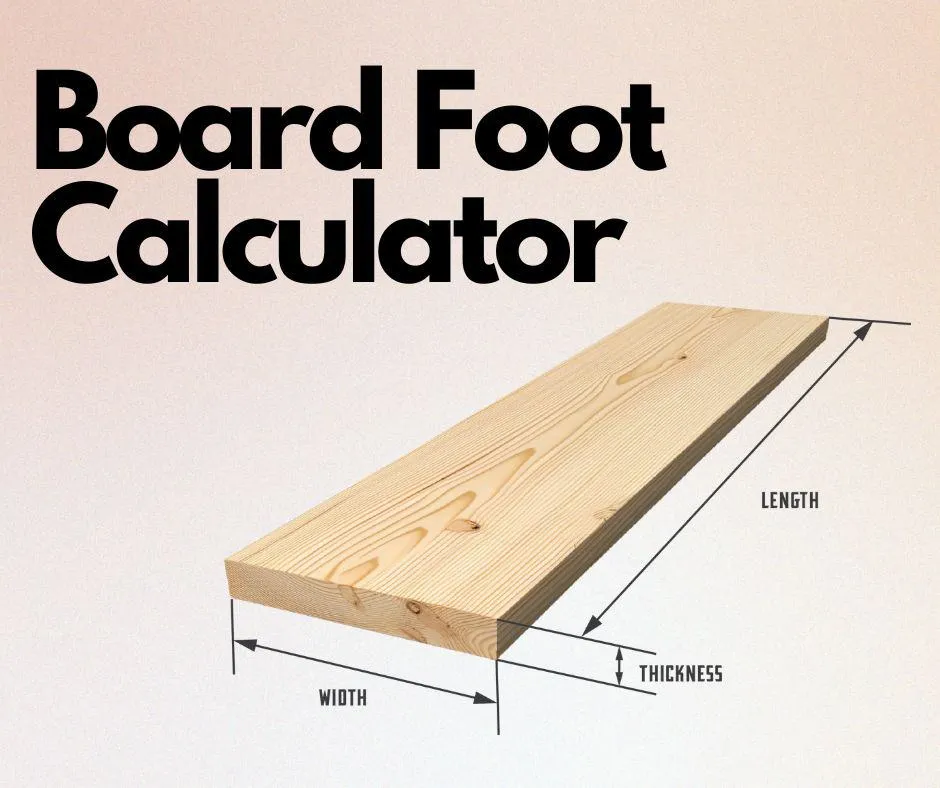
One board foot represents a piece of wood that is:
- 12 inches long
- 12 inches wide
- 1 inch thick
It does not mean that every board has to physically have these dimensions. A board can have a completely different shape or size and still contain one or more board feet.
For example, a wider board can contain the same volume as a longer but narrower board.
This makes board feet useful when you want to compare the amount of wood in different pieces rather than simply comparing their lengths.
The Basic Board-Foot Formula
The traditional formula is straightforward:
Board Feet = Length (inches) × Width (inches) × Thickness (inches) ÷ 144
There is another commonly used version when the length is measured in feet:
Board Feet = Length (feet) × Width (inches) × Thickness (inches) ÷ 12
Both formulas can produce the same result as long as the measurements are entered correctly.
The first formula is convenient when all three dimensions are measured in inches. The second can be easier when the length of the lumber is already given in feet.
How to Measure the Lumber
Before calculating board feet, measure the actual piece of lumber.
Start with the length. If you are using the formula with inches, measure the length in inches. Then measure the width across the face of the board and check its thickness.
It is important to distinguish between the width and thickness. Width is normally the larger face dimension, while thickness refers to the distance from one side of the board to the other.
For rough lumber, measurements may not always be perfectly uniform. If the board varies significantly in size, you may need to take the measurements at suitable points and use an appropriate estimate.
A Simple Example
Suppose you have a board that is 8 feet long, 10 inches wide, and 2 inches thick.
Using the feet-and-inches formula:
8 × 10 × 2 ÷ 12 = 13.33 board feet
So the board contains approximately 13.33 board feet.
If you have several boards with exactly the same dimensions, you can multiply that figure by the number of boards.
For example, five boards of the same size would contain approximately:
13.33 × 5 = 66.65 board feet
This is manageable for a few pieces, but manual calculations can become tedious when a project requires many boards.
Using an Online Calculator
When there are multiple pieces of lumber to measure, an online calculator can make the process more convenient.
Instead of repeatedly writing the formula and calculating each result, you can enter the dimensions into a how to measure board feet tool and use the result to check your estimate.
This can be especially useful when boards have different lengths, widths, or thicknesses.
It is still worth understanding the calculation because knowing how the result is produced makes it easier to spot an incorrect measurement or unit.
What About Different Board Sizes?
Woodworking projects rarely use one standard board size for everything.
A project may include long boards for the main surface, shorter pieces for supports, and smaller sections for trim. Each group can have its own dimensions.
One practical way to handle this is to group boards with matching dimensions together.
Calculate the board-foot amount for one board, multiply it by the number of boards in that group, and then add the totals from the other groups.
Keeping the calculations separated also makes the final estimate easier to review.
Nominal vs. Actual Dimensions
Another detail worth knowing is that lumber dimensions can sometimes be described differently from the measurements you get when you actually measure the board.
For example, a board sold under a particular nominal size may have smaller actual dimensions after it has been dried and surfaced.
If you are estimating the amount of lumber based on board feet, check whether your calculation should use the nominal dimensions or the actual dimensions.
The answer can depend on the type of lumber and how it is being sold.
Using the wrong dimensions can change the final figure, particularly when you are calculating a large quantity.
Estimating Material for a Project
Board feet can help with estimating the amount of lumber needed, but the result should not automatically be treated as the exact amount to purchase.
Some wood may be unsuitable because of defects. Cutting boards to specific lengths can also create offcuts that cannot be used elsewhere in the project.
For this reason, many woodworkers allow some additional material when purchasing lumber.
The amount of extra material depends on the design, the quality of the lumber, and how efficiently the boards can be cut.
A straightforward project with few cuts may have less waste than a detailed project with many small components.
Keep Your Measurements Organized
If you are working with several boards, keeping a simple measurement list can save time.
For each board or group, record:
- Length
- Width
- Thickness
- Number of pieces
- Board-foot result
This gives you a clear record of where the final total came from.
It also makes it easier to correct the calculation if you discover that one measurement was entered incorrectly.
For larger projects, a spreadsheet can be useful because you can keep the measurements together and update quantities without starting the entire calculation again.
Why Accurate Measurements Matter
Board-foot calculations are only as reliable as the measurements behind them.
A small difference in thickness or width can affect the final result. This becomes more noticeable when you are dealing with many boards.
Take your time when measuring, particularly with rough or irregular lumber. Make sure your measuring tool is positioned correctly and that you are reading the scale accurately.
It is also a good idea to check the units before entering the numbers into a calculator.
Board Feet Are About Volume
One thing that can make board feet easier to understand is remembering that the measurement represents volume.
Two boards can have very different dimensions but contain a similar amount of wood.
For example, one board might be long and narrow while another is shorter and wider. Their lengths alone would suggest that they are very different, but board-foot measurement takes all three dimensions into account.
This is why the measurement can be useful when comparing lumber quantities.
Overview
Measuring board feet is a useful skill for anyone who works with lumber. Once you understand the basic formula, calculating the volume of individual boards becomes fairly simple.
The process gets more time-consuming when a project contains many pieces with different dimensions. In those situations, an online calculator can reduce repetitive arithmetic and provide a convenient way to check your numbers.
The most important step is still accurate measuring. Record the length, width, and thickness carefully, use the correct units, and remember that the final estimate may need an allowance for waste.
With those basics in place, board-foot calculations become a practical part of planning a woodworking project.