How to Calculate Attendance Percentage and Stay on Track
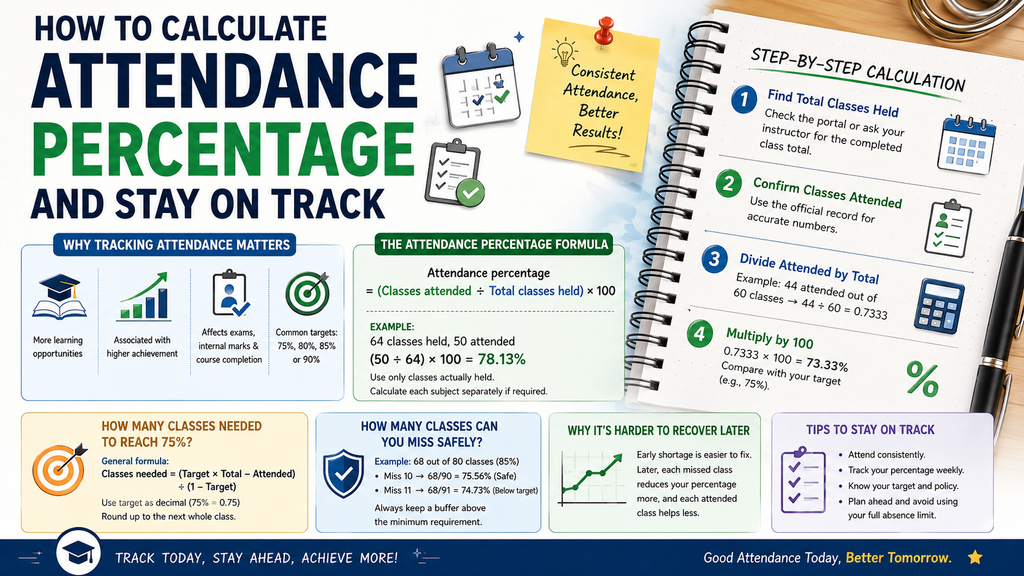
Attendance can feel unimportant at the beginning of a semester. Missing one lecture seems harmless, and there appears to be plenty of time to recover. A few weeks later, many students discover that their percentage is close to the minimum requirement. At that point, guessing is no longer safe.
Attendance is predictable when you use the right numbers. You can calculate your current percentage, estimate how many consecutive classes you need, and determine whether an absence will put you below your target. This guide explains each calculation and offers a simple semester-long routine.
Why Tracking Attendance Matters
Attendance is more than an administrative number, and checking it with an attendance calculator regularly can help you stay ahead of it before it becomes a problem. Present students have direct access to explanations, discussions, demonstrations, announcements, and questions. The National Center for Education Statistics reports that regular attendance gives students more opportunities to learn and is associated with higher achievement.
Attendance may affect exam eligibility, internal marks, course completion, practical requirements, or participation grades. A commonly discussed target is 75%, but it is not universal. Some departments require 80%, 85%, or 90%, while others evaluate each subject separately.
Confirm the requirement through your student portal, course handbook, department, or instructor. A calculator supports planning but cannot replace official policy or records.
The Attendance Percentage Formula
The basic attendance percentage formula is:
Attendance percentage = (Classes attended ÷ Total classes held) × 100
Suppose 64 classes have been held and you attended 50. The calculation is:
(50 ÷ 64) × 100 = 78.125%
Your current attendance is therefore 78.13% when rounded to two decimal places.
Use only classes actually held. Exclude future lectures, holidays, and cancelled sessions. If attendance is recorded by subject, calculate each one separately.
Should You Calculate Attendance by Days or Classes?
Use the unit your institution uses. Schools may record full or half days, while colleges often count individual lectures, tutorials, or labs. The formula remains the same, but the two units should never be mixed.
For day-based attendance, divide days present by school days completed. For class-based attendance, divide lectures attended by lectures held. If you were present on campus but missed one lecture, a day-based record might show you as present while a subject record shows an absence.
This difference explains why a personal calculation may not always match the portal. Before planning future absences, confirm whether your target applies to the whole term, each course, practical sessions, or all of these separately.
How to Calculate Attendance Step by Step
1. Find the Total Number of Classes Held
Check the portal or ask your instructor for the completed-class total, including attended and missed classes.
2. Confirm How Many Classes You Attended
Use the official record whenever possible. Personal notes may omit corrections, approved activities, or late updates.
3. Divide Attended Classes by Total Classes
If you attended 44 out of 60 classes, divide 44 by 60. The result is 0.7333.
4. Multiply the Result by 100
Multiplying 0.7333 by 100 gives 73.33%. If your target is 75%, you currently have an attendance shortage.
Manual calculation works, but future totals change and are easy to miscalculate. An attendance calculator can show your current rate and how many classes you may need to attend or can afford to miss for your chosen target.
How Many Classes Are Needed to Reach 75% Attendance?
A common mistake is assuming one attended class raises the percentage by one point. In fact, both the attended number and total increase.
Return to the example of 44 attended classes out of 60:
Current attendance = 73.33%
After attending one class, the record becomes 45 out of 61, which is 73.77%. After four consecutive attended classes, it becomes 48 out of 64, which is exactly 75%.
The general formula for the number of future classes needed is:
Classes needed = (Target rate × Total classes − Classes attended) ÷ (1 − Target rate)
Write the target as a decimal, so 75% becomes 0.75. Round the answer up to the next whole class because rounding down could leave you short.
How Many Classes Can You Miss Safely?
Students above their target often ask how many classes they can miss. Treat the answer as a planning limit, not an invitation to skip. Illness, transport problems, timetable changes, or recording errors can remove a narrow margin.
Imagine that you attended 68 of 80 classes. Your current percentage is 85%, and your minimum target is 75%.
- If you miss 10 future classes, your record becomes 68 out of 90, or 75.56%.
- If you miss 11 classes, it becomes 68 out of 91, or 74.73%.
Ten is the mathematical maximum in this example, but using every available absence is risky. Keep a reasonable buffer above the minimum requirement.
Why Attendance Becomes Harder to Recover Later
An early attendance shortage can often be repaired with a small number of classes because the total is still low. Later in the semester, each new class has less influence on the overall percentage.
Improving from 70% to 75% after 20 classes is easier than making the same improvement after 100 classes. Weekly tracking therefore provides more time and remaining lectures for recovery.
Tracking also reveals patterns, such as absences in early classes, on one particular weekday, or after late work shifts. You can then address the cause rather than repeatedly dealing with the result.
A Simple Weekly Attendance Routine
A five-minute weekly review is usually enough to keep your attendance under control.
- Check the official record: Compare the portal with the classes you actually attended.
- Correct errors early: Contact the instructor politely if a class appears incorrectly marked.
- Calculate each subject: Do not rely only on an overall semester percentage if courses have separate requirements.
- Enter the correct target: Use the requirement published by your institution, not a percentage suggested by a friend.
- Keep a safety buffer: Aim above the minimum so that one emergency does not create a shortage.
- Plan known absences: Review appointments, travel, competitions, and family commitments before deciding what is manageable.
This routine makes attendance a manageable part of academic planning instead of a last-minute problem.
Common Attendance Calculation Mistakes
Counting Classes That Have Not Happened
Your current attendance percentage must use completed classes only. Future classes belong in a separate forecast.
Entering Absences Instead of Attended Classes
Most attendance tools require the total and attended classes. If you only know your absences, subtract them from the total to find the number of classes attended.
Combining Subjects With Separate Requirements
A strong percentage in one course may not compensate for a shortage in another. Follow the calculation method used by your institution.
Ignoring Labs and Practical Sessions
Laboratories, placements, tutorials, workshops, and clinical sessions may have separate attendance requirements. Check how your institution counts them.
Rounding Too Early
Keep decimal values until the final step. Early rounding can produce a misleading result near the required threshold, and institutional rounding policies may differ.
Treating an Estimate as an Official Decision
A result is only as reliable as the information entered. Medical leave, approved duty, late registration, make-up classes, and administrative corrections may follow different institutional rules.
Practical Ways to Improve Low Attendance
If you are below your required target, begin with an accurate recovery number and focus on the causes you can control.
- Add every class to a calendar and set a reminder before your travel time.
- Prepare books, devices, and clothes the previous evening for early lectures.
- Ask a classmate to alert you to timetable or classroom changes.
- Speak to your instructor or student-support office when health, disability, transport, work, or family responsibilities affect your attendance.
- Keep supporting documents for medical or officially approved absences.
- Review your percentage weekly instead of waiting until the examination period.
An attendance calculator cannot solve a serious underlying issue. If repeated absences involve health, anxiety, safety, caring responsibilities, or financial pressure, seek appropriate institutional support as early as possible.
Frequently Asked Questions
What Is the Easiest Way to Calculate Attendance Percentage?
Divide the number of classes attended by the total number of classes held and multiply the result by 100. You can also use an online attendance calculator to calculate your percentage and estimate future classes.
Is 75% Attendance Required Everywhere?
No. Attendance requirements vary between institutions, countries, programs, and individual subjects. Check your official course handbook or student portal for the exact requirement.
Can One Attended Class Increase Attendance by 1%?
Not necessarily. The increase depends on the existing number of attended and total classes. As the semester progresses, one additional class normally has a smaller effect on the percentage.
Should Cancelled Classes Be Included?
No. A cancelled lecture should not normally be included as a class held unless your institution records it differently.
How Many Classes Do I Need to Attend to Reach 75%?
The answer depends on your current attended and total classes. Both figures increase whenever you attend another lecture, so you must calculate future attendance rather than simply finding the current percentage difference.
Can an Attendance Calculator Confirm Exam Eligibility?
An attendance calculator can estimate whether your percentage meets the target you enter. However, only your school, college, or university can officially confirm examination eligibility and decide how approved absences or special cases are treated.
Final Thoughts
Attendance is easier to manage when you stop guessing. Use accurate records, apply the attendance percentage formula, and check your progress before a small shortage becomes difficult to recover.
If you are below the target, calculate how many consecutive classes you need to attend and create a realistic recovery plan. If you are above it, maintain a sensible safety buffer rather than using every mathematically available absence.
Treat the calculated result as a planning aid alongside your institution’s official policy. A short weekly check can reduce uncertainty, reveal problems early, and prevent unwanted attendance surprises near the end of the semester.